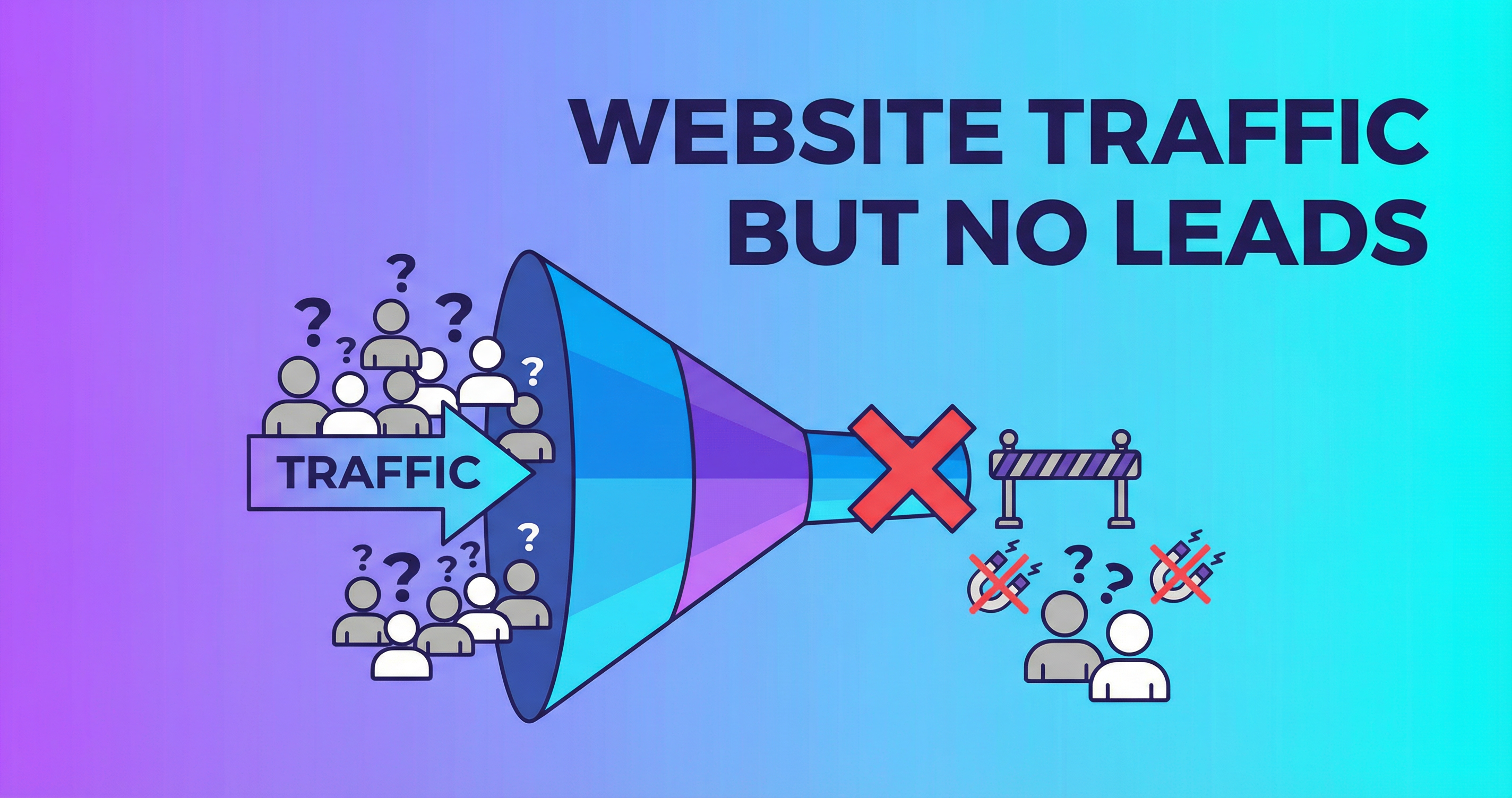

Getting traffic to your website is only half the battle. The real challenge is converting that traffic into actual leads — phone calls, form submissions, booked appointments, and sales.
If your website gets visitors but doesn't generate business, something is broken. Here's how to fix it and turn your website into a lead-generating machine.
Why Your Website Isn't Generating Leads
Before we talk solutions, let's diagnose the problems. Most business websites fail to generate leads because of one or more of these issues:
- Unclear messaging — Visitors don't immediately understand what you do or why they should choose you
- No clear CTA — There's no obvious next step for the visitor to take
- Slow loading — Visitors leave before the page even finishes loading
- Poor mobile experience — The site works on desktop but is frustrating on phones
- No trust signals — No reviews, testimonials, or portfolio examples
- Hard to contact — Phone number buried, no contact form, or form requires too many fields
- Weak content — Generic text that could apply to any business
Strategy 1: Optimize Your Homepage
Your homepage is your digital first impression. Within 3 seconds, a visitor should know:
- What you do
- Who you serve
- What makes you different
- What to do next
Your homepage needs a strong hero section with a clear headline, a benefit-driven subheading, and a prominent CTA button above the fold.
Strategy 2: Add Multiple Contact Methods
Different people prefer different ways of reaching out. Give them options:
- Phone number — Prominent, clickable, in the header on every page
- Contact form — Short (3-4 fields max), on every page or at least easily accessible
- Live chat — Real-time communication for people who want instant answers
- Email — For people who prefer written communication
- Text/SMS — Increasingly popular, especially for younger demographics
- Booking calendar — Let people schedule directly without back-and-forth emails
Strategy 3: Create Dedicated Service Pages
Don't list all your services on one page. Each service should have its own page with:
- Detailed description of what's included
- Benefits for the customer (not just features)
- Pricing or price ranges
- Testimonials from customers who used that specific service
- Before/after photos or case studies
- FAQ section addressing common questions
- Clear CTA specific to that service
Individual service pages also rank better on Google for specific search terms like "website design for small business."
Strategy 4: Add Lead Magnets
A lead magnet is something valuable you give away for free in exchange for contact information:
- Free guide or checklist — "10-Point Website Launch Checklist"
- Free consultation — "30-Minute Free Strategy Session"
- Free audit — "Free Website Performance Audit"
- Discount or coupon — "10% off your first order"
- Free quote or estimate — "Get Your Custom Quote in 24 Hours"
Lead magnets work because they reduce the perceived risk for the visitor. They get something valuable, and you get their contact info to follow up.
Strategy 5: Build Trust With Social Proof
Social proof is the #1 trust-builder on any website:
- Display Google reviews prominently
- Include video testimonials if possible (they're far more impactful than text)
- Show specific results: "Increased client's website traffic by 300%"
- Add trust badges (BBB, industry certifications, partner logos)
- Show the number of customers served or projects completed
Strategy 6: Implement Exit-Intent Popups
When someone is about to leave your site (their mouse moves toward the browser's close button), show them a popup with a compelling offer. These convert at 2-4% on average — which means for every 100 people who were about to leave, you capture 2-4 leads you would have lost.
Strategy 7: Speed Up Your Site
Every second of delay reduces conversions by 7%. If your site loads in 5 seconds instead of 2, you're losing ~21% of potential leads. Optimize images, clean up code, upgrade hosting — speed matters.
Track Everything
You can't improve what you don't measure. Set up:
- Google Analytics to track visitor behavior
- Goal tracking for form submissions and phone calls
- Heatmap tools to see where people click and how far they scroll
- A/B testing to continuously optimize your most important pages
I Build Lead-Generating Websites
Every website I build is designed with one goal in mind: bringing you more customers. From strategic CTAs to optimized contact forms to fast loading speeds — every element is purposeful.